I’m at the point now where writing this in French would probably be plus facile [easier] and certainly more natural. For the sake of my Anglophone readers, however, I will do my best with my limited English vocabulary and warped, French-tinged syntax.
I was about to compose this blog as a list of all the milliers [thousands] of wonderful things that I did this weekend, but I realized that I have been listing a lot recently.
So I’ll skip the myriad ways I have been profiting from Paris and focus on my après-midi [afternoon] which was spent 88 kilometers from the city. Two friends and I decided to benefit from our semi-vacances [vacation] by visiting the charming town of Chartres and its famed cathedral.
For me, the train ride from Gare Montparnasse southwest through the banlieues [suburbs] and subsequent quaint towns and fields was as rewarding as the visit of Chartres itself. To leave the hubbub of Paris for the open skies – même si [even if] they were sad and cloud-filled on this sunless day – always fills me with such happiness. I love remembering that there is a France outside of Paris, even if Parisians themselves have trouble with this concept. The massive, open expanses of fields and the beautiful tree-lined creeks only add to this child-like joy.
After passing our hour-long ride in a silence that was a mixture of awe, paresse [laziness] and repose [rest], we had arrived at our destination. Already, the town’s massive cathedral was hard to miss. We headed straight there and marveled at its ancient façade. We marveled too at the expansive vista of the town of Chartres visible from behind the architectural wonder. I wouldn’t say that the view of the town was particularly beautiful, but it was undeniably pleasant to stand at such a precipice and take in the fresh air of la campagne [the country]. It’s a bit hard to understand and probably irrational, but for some reason, each breath seems different away from Paris.
When we finally entered the cathedral, we were not disappointed. Its vibrant stained glass was beautiful, and its sheer échelle [scale] was breathtaking.
After leisurely taking in the magic of the cathedral, we strolled about the tiny streets of Chartres and eventually found a local brasserie where we warmed up with some boissons chauds [hot drinks]. It was so pleasant to observe the regulars prennent leur bière [drink their beers] at the counter and the mothers bring their children in for an afterschool treat.
Before hopping on our train, we grabbed some pâtisseries to hold us over until dinner. Waving good-bye to Chartres and its lovely cathedral, we sped back to Paris.
Showing posts with label churches. Show all posts
Showing posts with label churches. Show all posts
24 February 2009

16 February 2009
Ce que je veux faire avant de rentrer
As promised, here's my semi-translated first draft of my list of things that I want to do before leaving Paris. It's random and it's so much, but I think I can do it!
See at least one playFinish my "City Walks of Paris"Find all the landmarks from the filmCharadeWatch at least one more French movie at a theaterRead along one of the quais of Ile Saint-LouisDrink with friends on the quais of the Seine/Pont des arts/along Canal St.-MartinWatch at least one film from the Nouvelle Vague at the film libraryActually send people postcards !Watch a French film at Reid HallSee the French production of The Lion KingGo to the Comédie FrançaiseEat a macaroonGo to the flea markets
- See the following expositions before their respective end dates:
« Notorious » (le 22 février)« Rapa Nui, L'Ile de Pâques » (le 1er mars)« Instants d'architecture » à la Maison du Danemark (le 8 mars)« Gainsbourg 2008 » à la Cité de la Musique (le 15 mars)« Le petit dessein » au Louvre (le 13 avril)« 80 + 80, photo_graphisme » (le 25 avril)« Le Petit Nicolas» (le 7 mai)
- Visit the following:
Musée de PicassoMaison de Victor HugoMusée RodinL'OrangerieMusée d’art moderne de la ville de Paris (again)Musée de ClunyMusée de la vie romantiqueEspace Krajcberg
- Outside of Paris:
GivernyA weekend trip with my momThe South of FranceBois de BoulogneBois de VincennesTake a day trip to one other French city outside of ParisBrussels
Look at the gare Saint-LazareLook at the gare de l'EstGo in Notre-DameFind Guy de Maupassant's tomb at the Cemetery MontparnasseReturn to see the auditorium of the Opera
- Explore:
Parc MontsourisCemetery Montmartre
This list is a "work in progress," and I'll be returning to add things or cross things out as I do them!
21 January 2009
La troisième ville : Vienne
I just watched The Third Man – an excellent film noir set in 1949 Vienna – this afternoon and was, thus, inspired to complete my travel triptych with my tales from Wien.
Of our three destinations, Vienna was the city that reminded me the most of Paris. Its late-19th-century buildings are of a similar architecture as those of Paris.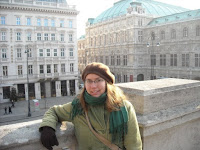 Its Habsburg palaces blatantly recall the style and opulence of Versailles. And of the three cities, it was the place where I felt the guiltiest for not being able to speak the language. Although the Austrians didn’t seem as fervently zealous in their protection of German as the French are of their language, English was less common than in Amsterdam (where it was ubiquitous) and less appreciated than in Prague (where I detected mild amusement from those with which I spoke in English). I guess the city served as a good transition back to Paris.
We pulled into the bus station in Vienna around noon and proceed to the U-Bahn – Vienna’s equivalent of the Metro – where we successfully purchased our 72-hour passes and boarded the train in the direction of our accommodations. Thanks to a detailed map of the area that we had sketched out, using Google Maps, the night before, we avoided conflict and made it easily to the Elisabeth Guesthouse. When we arrived there was no on in sight and no response upon ringing the bell. We were searching for their phone number amongst my paperwork and standing confused in the hallway for a number of minutes when an endearing old Austrian man emerged from a nearby doorway. He eventually led us to our room which was more like a bitty apartment complete with kitchen and entryway.
We took the U-Bahn into town where we visited the impressive and very tall St. Stephen’s Cathedral. After that, we anticipated our standby tourism strategy of walking about the city looking at various pretty things. Unfortunately, the weather, which – coinciding with our departure from Prague – had recently turned frigid, foiled this tactic. We quickly grew very cold. We ducked into a nearby church to warm up, and Peterskirche [St. Peter’s Church] turned out to be a delightfully ornate Baroque art piece.
Fighting off the cold, we continued on to get a look at the Hofburg Palace, pride of the Habsburgs, and carried on to the MuseumsQuartier, an overly conceptual mall/museum complex where it seemed a number of things were closed. This was the moment when we began to realize that the Austrians must celebrate some sort of Boxing-Day-like holiday for which life shuts down on the day after Christmas. We began to fear the fermeture [closure] of all eating establishments, and dinner plans became a concern. Luckily, we had blown our remaining crowns on snacks at our nonstop convenience store in Prague so at least we wouldn’t go hungry. Nevertheless, we decided to walk the length of a major thoroughfare in search of something warm to eat. The only place open was MacDo [McDonald’s], and although we were reluctant – we passed one up before ultimately deciding to give in at the next – it turned out to be worth it, if only for the intriguing cross-cultural exchange that took place as I tried to order from the entertained (and entertaining) German-speaking cashier.
We called it a night and decide we would need to make more concrete plans for the next day in order to avoid growing bitter and cold on the streets of Vienna.
 Saturday we hit up a grocery store, realizing the severity of our lack of food. We then hopped on the U-Bahn for the Belvedere. To get there we had to switch to the S-Bahn – Vienna’s equivalent of the RER – and thanks to some incompetency in reading signs we passed by the Prater theme park which allowed us to see the Ferris wheel featured in a dramatic scene between Joseph Cotten and Orson Welles in The Third Man.
We eventually headed back in the right direction and arrived at the Belvedere. Originally the summer palace of Prince Eugene of Savoy, it now hosts an impressive art collection. It understandably had an impressive selection of Klimts; although I don’t think I had heard of him before this trip, I grew to love the work of Gustav Klimt, pride of the modern Vienna art scene. The grand staircase and impressive rooms of both the Upper and
  Lower Belvedere buildings were also a treat. Plus, the French garden connecting them made me feel at home.
We ended up passing our day amongst the art and stopped off to look at the beautifully lit Karlskirche [St. Charles’s Church] before heading home for the night.
On our last day in Vienna, we stopped by the Secessionist Building whose art nouveau exterior was eye-catching and the Opera which was a bit of a rip-off of Paris’s Opera Garnier.
We spent most of the day in the Albertina, yet another palace-cum-gallery, where a recently donated personal collection featured works by painters from Monet to Picasso and everyone in between (and even some after like Francis Bacon and Mark Rothko). A random smattering of contemporary Austrian art with poorly written – or poorly translated – accompanying text also held our attention. The Habsburg staterooms were equally thrilling, presenting the allure of a fully reconstructed timepiece with prints from Dürer and others decorating the walls. This mixture of luxury and art was particularly appealing to me. It’s like getting two attractions for the price of one!
After I bought some chocolates as a souvenir for my host mom, we began our search around the St. Stephen’s Cathedral for some “Viennese treats” to cap off our stay. Apparently I am spoiled from living in Paris where cafés line the streets and dot each corner, but it was harder than expected to find a suitable establishment. We did eventually locate this immense eatery where I had the milkshake I had been looking for all week and some tiramisu – don’t judge…it’s required to indulge while on vacation – and Ben got a classic apple strudel. Before saying goodbye to Vienna we took the U-Bahn out to Schönbrunn Palace, the Habsburg’s summer retreat, to snap some photos and stare.
Of our three destinations, Vienna was the city that reminded me the most of Paris. Its late-19th-century buildings are of a similar architecture as those of Paris.
 Its Habsburg palaces blatantly recall the style and opulence of Versailles. And of the three cities, it was the place where I felt the guiltiest for not being able to speak the language. Although the Austrians didn’t seem as fervently zealous in their protection of German as the French are of their language, English was less common than in Amsterdam (where it was ubiquitous) and less appreciated than in Prague (where I detected mild amusement from those with which I spoke in English). I guess the city served as a good transition back to Paris.
We pulled into the bus station in Vienna around noon and proceed to the U-Bahn – Vienna’s equivalent of the Metro – where we successfully purchased our 72-hour passes and boarded the train in the direction of our accommodations. Thanks to a detailed map of the area that we had sketched out, using Google Maps, the night before, we avoided conflict and made it easily to the Elisabeth Guesthouse. When we arrived there was no on in sight and
 no response upon ringing the bell. We were searching for their phone number amongst my paperwork and standing confused in the hallway for a number of minutes when an endearing old Austrian man emerged from a nearby doorway. He eventually led us to our room which was more like a bitty apartment complete with kitchen and entryway.
We took the U-Bahn into town where we visited the impressive and very tall St. Stephen’s Cathedral. After that, we anticipated our standby tourism strategy of walking about the city looking at various pretty things. Unfortunately, the weather, which – coinciding with our departure from Prague – had recently turned frigid,
 foiled this tactic. We quickly grew very cold. We ducked into a nearby church to warm up, and Peterskirche [St. Peter’s Church] turned out to be a delightfully ornate Baroque art piece.
Fighting off the cold, we continued on to get a look at the Hofburg Palace, pride of the Habsburgs, and carried on to the MuseumsQuartier, an overly conceptual mall/museum complex where it seemed a number of things were closed. This was the moment when we began to realize that the Austrians must celebrate some sort of Boxing-Day-like holiday for which life shuts down on the day after
 Christmas. We began to fear the fermeture [closure] of all eating establishments, and dinner plans became a concern. Luckily, we had blown our remaining crowns on snacks at our nonstop convenience store in Prague so at least we wouldn’t go hungry. Nevertheless, we decided to walk the length of a major thoroughfare in search of something warm to eat. The only place open was MacDo [McDonald’s], and although we were reluctant – we passed one up before ultimately deciding to give in at the next – it turned out to be worth it, if only for the intriguing cross-cultural exchange that took place as I tried to order from the entertained (and entertaining) German-speaking cashier.
We called it a night and decide we would need to make more concrete plans for the next day in order to avoid growing bitter and cold on the streets of Vienna.
Saturday we hit up a grocery store, realizing the severity of our lack of food. We then hopped on the U-Bahn for the Belvedere. To get there we had to switch to the S-Bahn – Vienna’s equivalent of the RER – and thanks to some incompetency in reading signs we passed by the Prater theme park which allowed us to see the Ferris wheel featured in a dramatic scene between Joseph Cotten and Orson Welles in The Third Man.We eventually headed back in the right
 direction and arrived at the Belvedere. Originally the summer palace of Prince Eugene of Savoy, it now hosts an impressive art collection. It understandably had an impressive selection of Klimts; although I don’t think I had heard of him before this trip, I grew to love the work of Gustav Klimt, pride of the modern Vienna art scene. The grand staircase and impressive rooms of both the Upper and
  Lower Belvedere buildings were also a treat. Plus, the French garden connecting them made me feel at home.
We ended up passing our day amongst the art and stopped off to look at the beautifully lit Karlskirche [St. Charles’s Church] before heading home for the night.
On our last day in Vienna, we stopped by the Secessionist Building
 whose art nouveau exterior was eye-catching and the Opera which was a bit of a rip-off of Paris’s Opera Garnier.
We spent most of the day in the Albertina, yet another palace-cum-gallery, where a recently donated personal collection featured works by painters from Monet to Picasso and everyone in between (and even some after like Francis Bacon and Mark Rothko). A random smattering of contemporary Austrian art with poorly written – or poorly translated – accompanying text also held our attention. The Habsburg staterooms were equally thrilling, presenting the allure of a fully reconstructed timepiece with prints from Dürer and others decorating the walls. This mixture of luxury and art was particularly appealing to me. It’s like getting two attractions for the price of one!
After I bought some chocolates as a souvenir for my host mom, we began our search around the St. Stephen’s Cathedral for some “Viennese treats” to cap off our stay. Apparently I am spoiled from living in Paris where cafés line the streets and dot each corner, but it was harder than expected to find a suitable establishment. We did eventually locate this immense eatery where I had the milkshake I had been looking for all week and some tiramisu – don’t judge…it’s required to indulge while on vacation – and Ben got a classic apple strudel. Before saying goodbye to Vienna we took the U-Bahn out to Schönbrunn Palace, the Habsburg’s summer retreat, to snap some photos and stare.
The next day, despite frustrations with the S-Bahn which decided to cancel a train making us wait on the cold quai [platform] for a good hour and ten minutes, we made it to the Vienna Airport and happily boarded our plane back to Paris.
04 January 2009
Amsterdam sans souci
With the songs of the same name by Guster and Peter Bjorn & John ringing in my ears, Ben and I set off for Amsterdam ridiculously early on the day after my last class before break.
The train plowed through Belgium quicker than the Germans (too soon? I don’t think so) and made stops at all of the Netherlands’ major cities – which are surprisingly close together even for the tiny speck of a country that is Holland – before finding its terminus and our destination at Amsterdam’s Central Station.
 Once we had located our adorable, canal-side hotel, one member of our party took an epic nap while the other explored the nearby Museum Quarter and the adorable Prince William Canal, noting interesting restaurants and attractions along the way. For dinner, we tried out the nearby Pancake Corner where I ate a “pizza pancake,” and Ben tapped his England nostalgia for some fish and chips.
We ended our night at the Van Gogh Museum which is open in nocturne Friday nights, complete with DJ. The atmosphere was fun, and the art was great. The large collection of Van Goghs was laid out chronologically, and detailed texts – always translated in perfect English – gave context and insight into Van Gogh’s troubled psyche.
The next day was full of walking – a common theme of our vacation(s) – and colonialism. We walked “Farther Afield” as our guidebook put it to the Tropenmuseum. Formerly a testament to the colonial glory of the Netherlands (yes, the tiny country was a colonial power, controlling the massive Indonesia for hundreds of years), the “Tropical Museum” now hopes to offer ethnographic “stories” from across the world. It was a bit like the Musée Quai Branly but much more anthropological. And although the cartoon Indian with an accent fit for Apu clearly crossed the line of good taste and cultural sensitivity, the museum was well-done and held the attention of two self-proclaimed po-co enthusiasts. Plus, an exhibition on the influence of Vodou in Haiti was enlightening and surprising.
After learning that the National Maritime Museum was closed for renovation – along with half of Amsterdam – we strolled about the harbor and back to the Leidseplein, the bustling plaza located near our hotel. We chose a British sports bar for dinner. This helped to cement Ben’s theory that Amsterdam is really just an extension of the UK. He says that Amsterdam was the most like Great Britain of any city he’s been to (outside of GB, of course).
The omnipresence of English and Dutch’s tonal familiarity helped to add to this Anglophonic atmosphere, but for me, the most important factor was le style de vie of the Dutch. They seemed so laid back, so breezy, so…happy. After living in Paris for four months, it was a shock to see Europeans who looked and acted carefree. They smiled and laughed as they passed, leisurely riding their bicycles. They weren’t overly concerned with their outfits, and they weren’t threatened by the English language the way the French are. They were visibly happy, something so rare chez les Français. It was a welcome break from my French surroundings.
Our third day in Amsterdam was filled with more museums. Having purchased a money-saving “museumkaart,” we had free access to all the state-run museums; tapping our frugal Dutch heritage, we profited. Although Amsterdam’s equivalent to the Louvre, the Rijksmuseum (“state museum”) was limited due to renovations, it offered a very manageable selection of the Dutch masters, including a sizeable Rembrandt collection and a number of Vermeers.
We tried to stop in at the Filmmuseum, but after a confusing exchange with the friendly cashier, eventually learned that they didn’t have an exposition showing.
 The foam (fotografiemuseum Amsterdam) proved interesting, however, and we finished our night there before heading to the Pancake Bakery. Suggested by our guidebook, the intimate eatery offered over 50 varieties of traditional Dutch pancakes. Ben’s cinnamon-apple and my cheese pancakes were excellent, and the friendly service reminded me how different from Paris Amsterdam really was.
On our final day in the city, we finally embarked into the panic-attack inducing, tourist-filled areas of Amsterdam. Until this point, we’d mostly mingled amongst natives on the outskirts of town, but we decided we should see the city center before we departed. We dropped our bags off at Central Station and walked down Damrak. We found them alright; tourists swarmed the street like screaming teenagers at an ’N Sync concert circa 1999. Souvenir shops, fast food and tacky museums abounded. I found it hard to see the allure of this people-filled destination. I much preferred the quiet canals and local parks we had spent our first three days exploring. But the crowd-think mentality apparently rules among tourists. The good thing is this collective thinking makes them easy enough to avoid: simply hop on a side street or take the next road over and life will be nearly tourist-free.
After fighting off the crowds, we saw an intriguing contemporary art exhibit in the “New Church” – another Pont Neuf situation considering the church dates from the 15th century. Since Amsterdam’s contemporary art museum was closed for renovations – shocker – select pieces were on display within the church. The theme of spirituality united the exhibit, making the randomness of contemporary art more palatable. As always with the Dutch, the text accompanying the art was extensive and informative, this time presented in a take-home booklet.
We spent the afternoon in the amusing Amsterdam Historical Museum and passed by the “Old Church,” a 13th-century wonder located squarely in the Red Light District, just before closing.
We caught our bus to Prague later that night without a hitch.
We’d seen so much in Amsterdam that it felt like time to move on, but I was still sad to leave that laid-back Amsterdam style and those glorious canals behind.

The train plowed through Belgium quicker than the Germans (too soon? I don’t think so) and made stops at all of the Netherlands’ major cities – which are surprisingly close together even for the tiny speck of a country that is Holland – before finding its terminus and our destination at Amsterdam’s Central Station.
 Once we had located our adorable, canal-side hotel, one member of our party took an epic nap while the other explored the nearby Museum Quarter and the adorable Prince William Canal, noting interesting restaurants and attractions along the way. For dinner, we tried out the nearby Pancake Corner where I ate a “pizza pancake,” and Ben tapped his England nostalgia for some fish and chips.
We ended our night at the Van Gogh Museum which is open in nocturne Friday nights, complete with DJ. The atmosphere was fun, and the art was great. The large collection of Van Goghs was laid out chronologically, and detailed texts – always translated in perfect English – gave context and insight into Van Gogh’s troubled psyche.
The next day was full of walking – a common theme of our vacation(s) – and colonialism. We walked “Farther
 Afield” as our guidebook put it to the Tropenmuseum. Formerly a testament to the colonial glory of the Netherlands (yes, the tiny country was a colonial power, controlling the massive Indonesia for hundreds of years), the “Tropical Museum” now hopes to offer ethnographic “stories” from across the world. It was a bit like the Musée Quai Branly but much more anthropological. And although the cartoon Indian with an accent fit for Apu clearly crossed the line of good taste and cultural sensitivity, the museum was well-done and held the attention of two self-proclaimed po-co enthusiasts. Plus, an exhibition on the influence of Vodou in Haiti was enlightening and surprising.
After learning that the National Maritime Museum was closed for renovation – along with half of Amsterdam – we strolled about the harbor and
 back to the Leidseplein, the bustling plaza located near our hotel. We chose a British sports bar for dinner. This helped to cement Ben’s theory that Amsterdam is really just an extension of the UK. He says that Amsterdam was the most like Great Britain of any city he’s been to (outside of GB, of course).
The omnipresence of English and Dutch’s tonal familiarity helped to add to this Anglophonic atmosphere, but for me, the most important factor was le style de vie of the Dutch. They seemed so laid back, so breezy, so…happy. After living in Paris for four months, it was a shock to see Europeans who looked and acted carefree. They smiled and laughed as they passed, leisurely riding their bicycles. They weren’t overly concerned with their outfits, and they weren’t threatened by the English language the way the French are. They were visibly happy, something so rare chez les Français. It was a welcome break from my French surroundings.
Our third day in Amsterdam was filled with more museums. Having purchased a money-saving
 “museumkaart,” we had free access to all the state-run museums; tapping our frugal Dutch heritage, we profited. Although Amsterdam’s equivalent to the Louvre, the Rijksmuseum (“state museum”) was limited due to renovations, it offered a very manageable selection of the Dutch masters, including a sizeable Rembrandt collection and a number of Vermeers.
We tried to stop in at the Filmmuseum, but after a confusing exchange with the friendly cashier, eventually learned that they didn’t have an exposition showing.
 The foam (fotografiemuseum Amsterdam) proved interesting, however, and we finished our night there before heading to the Pancake Bakery. Suggested by our guidebook, the intimate eatery offered over 50 varieties of traditional Dutch pancakes. Ben’s cinnamon-apple and my cheese pancakes were excellent, and the friendly service reminded me how different from Paris Amsterdam really was.
On our final day in the city, we finally embarked into the panic-attack inducing, tourist-filled areas of Amsterdam. Until this point, we’d mostly mingled amongst natives on the outskirts of town, but we decided we should see the city center before we departed. We dropped our bags off at Central Station and walked down Damrak. We found them alright; tourists swarmed the street like screaming teenagers at an ’N Sync concert circa 1999. Souvenir shops, fast food and tacky museums abounded. I found it hard to see the allure of this people-filled destination. I much preferred the quiet canals and local parks we had spent our first three days exploring. But the crowd-think mentality apparently rules among tourists. The good thing is this collective thinking makes them easy enough to avoid: simply hop on a side street or take the next road over and life will be nearly tourist-free.
After fighting off the crowds, we saw an intriguing contemporary art exhibit in the “New Church” – another
 Pont Neuf situation considering the church dates from the 15th century. Since Amsterdam’s contemporary art museum was closed for renovations – shocker – select pieces were on display within the church. The theme of spirituality united the exhibit, making the randomness of contemporary art more palatable. As always with the Dutch, the text accompanying the art was extensive and informative, this time presented in a take-home booklet.
We spent the afternoon in the amusing Amsterdam Historical Museum and passed by the “Old Church,” a 13th-century wonder located squarely in the Red Light District, just before closing.
We caught our bus to Prague later that night without a hitch.
We’d seen so much in Amsterdam that it felt like time to move on, but I was still sad to leave that laid-back Amsterdam style and those glorious canals behind.
24 September 2008
L’Eglise parisienne
I’m not a religious person. I never really have been. I have my only particular breed of beliefs that border between atheism and agnosticism. I quietly decline to believe in God and I’m OK with that. But lately, the magnifique [magnificent, in a visually stunning way] churches that I’ve been seeing are making me wonder if I am missing out. To think that someone – some people – possessed a faith so strong that they constructed these physically massive and overwhelming beautiful structures in honor of their God astounds me. There’s something very moving about a faith that strong, and it is reflected, permanently and stunningly in the columns, the buttresses, the stained glass and the rafters of so many Parisian churches.
Here, the vestiges of this insurmountably strong faith are everywhere. Everyone knows la Cathédrale Notre-Dame, and even most tourists discover la Basilique du Sacré-Cœur and Sainte-Chapelle. All three are marvels, wonders of architecture, art and sheer human ability. But what some don’t realize is that awe-inspiring churches loom around nearly every corner of this historically and symbolically Catholic city.
As part of last weekend’s Journées du Patrimoine [Heritage Days], after visiting the Panthéon, a laïque [non-religious, secular] version of the awe-inspiring French church, I decided to enter for the first time a number of these churches, found scattered about my quartier [neighborhood].
Saint-Etienne-du-Mont, Saint-Germain-des-Prés, Saint-Sulpice and Notre-Dame-des-Champs are all within reasonable walking distance of my house and each one is as breathtaking as the next. I’m not only moved by the sheer size and magnitude of these human creations, but I also find moving the act of entering each church. Passing through those heavy, imposing doors, I shut out the hustle and bruit [noise] of Boulevard du Montparnasse, or whichever bustling Paris street, in favor of a perfect calm and reflective quiet. I almost feel guilty intruding upon this serenity as I thrust my head sky-ward in awe of the intricate ceiling or beautifully colored glass.
It’s overwhelming.
Il fait parfois me demander si jamais je peux avoir autant de foi…en n’importe quoi. [Sometimes it makes me wonder if I could ever have that much faith…in anything.]
Here, the vestiges of this insurmountably strong faith are everywhere. Everyone knows la Cathédrale Notre-Dame, and even most tourists discover la Basilique du Sacré-Cœur and Sainte-Chapelle. All three are marvels, wonders of architecture, art and sheer human ability. But what some don’t realize is that awe-inspiring churches loom around nearly every corner of this historically and symbolically Catholic city.
As part of last weekend’s Journées du Patrimoine [Heritage Days], after visiting the Panthéon, a laïque [non-religious, secular] version of the awe-inspiring French church, I decided to enter for the first time a number of these churches, found scattered about my quartier [neighborhood].
Saint-Etienne-du-Mont, Saint-Germain-des-Prés, Saint-Sulpice and Notre-Dame-des-Champs are all within reasonable walking distance of my house and each one is as breathtaking as the next. I’m not only moved by the sheer size and magnitude of these human creations, but I also find moving the act of entering each church. Passing through those heavy, imposing doors, I shut out the hustle and bruit [noise] of Boulevard du Montparnasse, or whichever bustling Paris street, in favor of a perfect calm and reflective quiet. I almost feel guilty intruding upon this serenity as I thrust my head sky-ward in awe of the intricate ceiling or beautifully colored glass.
It’s overwhelming.
Il fait parfois me demander si jamais je peux avoir autant de foi…en n’importe quoi. [Sometimes it makes me wonder if I could ever have that much faith…in anything.]
Subscribe to:
Posts (Atom)